
One chart, different decisions
Two traders can look at the same gold chart and arrive at different decisions. Their positions, time horizons and rules may differ; so may the consequences they attach to being wrong. That difference is the starting question for this introduction to the Nervous System Indicator. On NSI.GOLD, Gabriel Nicolaev – CyGuru presents NSI as a proposed interdisciplinary research framework concerned with the human side of financial decisions. [1] The central distinction is useful: information about a market and information about the person interpreting it belong in separate records before anyone tries to connect them.
What the word indicator should make us ask
In a trading conversation, the word indicator can sound like a calculation that produces an entry instruction. A research framework needs a more precise introduction. What is being observed? How is it recorded? Which outcome is the proposed observation meant to explain? NSI.GOLD explicitly identifies independent validation as unfinished work. [1] That makes the relevant question whether a clearly defined observation adds useful information about decision consistency. It does not make the framework an established forecast of the next XAU/USD move. Precision here protects the meaning of the project: a promising question deserves to be tested on its own terms.
A practical distinction: exposure, experience and action
Consider a hypothetical trader watching a position move against its entry price. The position has financial exposure, the trader may describe an uncomfortable experience, and a later order records an action. None of those observations automatically establishes the cause of the others. A reduced position might follow a written rule, a revised analysis, an operational constraint or an unplanned response. A useful enquiry begins by recording what was planned and what actually happened. Before the Order provides a complementary structure for documenting the decision before the result is known.
Why a record is stronger than a retrospective label
Imagine writing “panic” beside every losing trade and “confidence” beside every profitable one. The labels would mostly repeat the outcome, giving little independent information about the decision. A more informative record would preserve the original reasoning, the available information, any change in the plan and the explanation given at the time. This is an editorial suggestion for organising observations, rather than a validated NSI measurement protocol. Its advantage is transparency: another reader can see the evidence without first accepting the label. A two-record trading journal develops this method with an illustrative example.
From this introduction to the book
The book The Gold Nervous System Indicator explores the relationship between neuroscience, behaviour and gold-trading decisions. Its product description identifies themes including perceived threat, reward, cognitive control and recovery, and presents the NSI model as research-oriented. [2] Those themes provide a reading route for anyone who wants to investigate why a decision can change while the written strategy stays the same. Read the book alongside the research on NSI.GOLD, then use the evidence checklist to distinguish an explanation, a measurement and a predictive claim. Understanding the boundaries makes the underlying enquiry more useful.
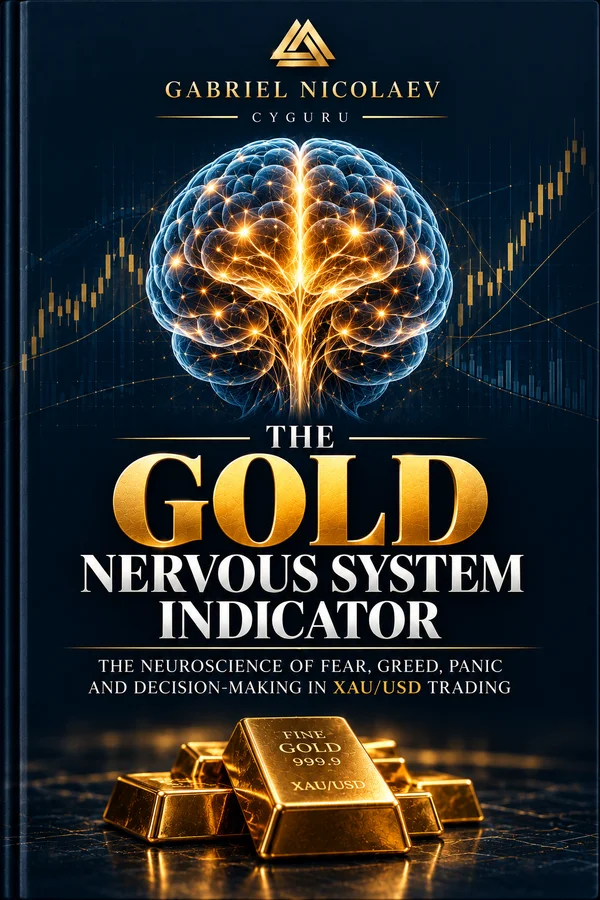
The Gold Nervous System Indicator
Discover the connection between the human factor and gold trading.
Discover the book ↗Read the book overview →Sources & further reading
- NSI.GOLD — Proposed framework and research status ↗
- Gabriel Nicolaev – CyGuru — The Gold Nervous System Indicator ↗
Sources consulted 27 October 2026. Editorial frameworks and illustrative examples are identified within the text.